Reviews (Pre-Publication)
Reviews (Pre-Publication)
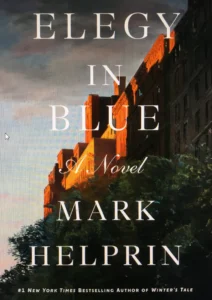
"Over the course of a long literary career, Mark Helprin has written novels and stories about the kind of men few of his contemporaries care to depict. His protagonists are courageous, noble, and strong. They have been shaped, but not deformed, by military service. They are loyal. They love deeply, and they are uncommonly perceptive. . . . “If you look at the world long enough and hard enough,” the narrator [of Elegy in Blue] assures us, “you will see that there is truth in it and that it is beautiful.”" (The Wall Street Journal)
"Helprin’s writing feels as if it comes from inside me rather than from an outside source. It comes with an old-world elegance that I’ve never spoken or written in, with sentence construction I’ve never used. How does he do that? . . . There is certainly nothing saccharine about his romantic vision – anything but. It is as if the passages are written by a pulsating heart." (Substack (Betsy Robinson))
"You should read Mark Helprin’s Elegy in Blue because it is witty, wise, and funny. . . . For dazzling literary showmanship, the example of James Joyce’s Ulysses comes to mind. . . . Like Joyce, Helprin fuels an encyclopedic mind with vast supplies of language. He is also indebted to the elegiac depths of Joyce’s short story “The Dead.” If asked to construct a literary genealogy for Elegy in Blue, I would point back to Tristram Shandy and Don Quixote. If asked to list more contemporary influences and congeners, I would name F. Scott Fitzgerald, Isaac Bashevis Singer, P.G. Wodehouse, Samuel Beckett, and Paul Auster. . . . Like Fitzgerald, he has the power to dwell on beauty in passages of sensuous reflection. . . . Early in the book, the reader encounters . . . this high lyrical power." (Civitas Outlook)
"America’s greatest living writer." (The Daily Wire)
"All of this – the action, the humor, and the reflections on the material and spiritual worlds – is delivered in prose that is both vivid and musical." (The Washington Independent Review of Books)
"A man’s good deed haunts the rest of his days. In this story “of love in a time of violence,” the narrator never reveals his name; he’s an octogenarian who reasonably expects that “terrible, powerful, soulless people are coming to kill me.” Yet his own soul is at peace. He loves the “hum of Brooklyn roads, the muffled roar of the BQE, and the sound of air whistling through the steel weave of the bridges…” Brooklyn is “embraced by the ocean, the harbor, the East River,” and its deep blue sky is a rhapsody that calms the heart. Yet with rhapsody comes tragedy. Then narrator recalls with melancholy his wife, Clare, their son, Charles, and the joy they all once brought to each other. But Charles died fighting in Iraq and Clare’s own violent passing nearly strips the narrator’s life of meaning. The couple—he once a rich investment banker, she a lawyer—enjoyed long walks from Brooklyn into Manhattan until one day a crazed man wielding a machete began butchering people. The narrator, then a 70-something Vietnam veteran, killed the attacker, but at a heavy and permanent cost. The ensuing events are nothing he could have anticipated, which is much to the readers’ benefit. A few years later, he saves a friend from the clutches of a drug gang, and he knows the gang is now coming for him. But he feels he’s lived his life and isn’t about to skip town to escape his likely death: “Emily Dickinson stuck like a limpet to Amherst,” he says. “Brooklyn is good enough for me.” The narrator reflects deeply on the family and possessions he once had, on his love of his family and his city, and on the ghosts to whom he owes allegiance. Had he known what was going to happen, would he have interrupted the machete attack? He and Clare could have kept walking, but they didn’t, and he is forever haunted by the consequences.
A wistful, captivating love letter to Brooklyn; a lament for loved ones lost and a life forever changed." (Kirkus Reviews)
"The achievement of this compelling audio book is its lyrical prose and moral center.
(For the audio book) The Kirkus Earphones Award" (Kirkus Reviews)
"Helprin (The Oceans and the Stars) delivers this saga with canny plotting and style without wasting a word. The narrator, an investment banker, now 82 years old, meditates in his modest Brooklyn apartment on disastrous turns in his life. His fortune has evaporated, his palatial home with valuable paintings has burned down, and his three primary loved ones have died in violent episodes. The novel, with Helprin’s writerly gift illuminating nearly every page, opens with a horrific street attack involving his wife. It ends with another horror—a seaborne attack on drug cartel criminals. The unnamed narrator is a principal actor in both incidents. With philosophic excursions, Helprin explores the time-honored but contradictory principles “Might makes right” and “The end does not justify the means.” He also pays homage to soaring romantic love between two well-developed characters bound by adoration and absolution.
VERDICT: While deep and introspective, this novel’s probing of ethics and morality is never ponderous. Describing the cobalt blue of Brooklyn’s sky and sea, Helprin’s language is poetic and lyrical. Expect to see this on many best-of-2026 lists." (Library Journal, Starred Review)
"The unnamed 82-year-old narrator of Helprin’s elegiac, deceptively witty novel has had a remarkable life but also one marked by tragedy, most recently when his wife Clare is killed by a machete-wielding madman during a mass casualty event. In the subsequent melee, the narrator kills the attacker, earning him the moniker, the One Percent Vigilante. What follows is a meditation on loss through the voice of this elderly man now in reduced circumstances. Once a titan of Wall Street, he now inhabits a humble aftermath while reflecting on the losses of his father, his son, and his wife, all taken from him across decades shaped by war and violence. He revisits the architecture of his life—ambition, love, pride, devotion, and the assumption that time would always allow for repair.
Helprin brilliantly gives the reader an external view to echo the interior landscape of a man stripped of illusion. This is an elegy for the dead, yet contained within this sorrow remains a fierce insistence that love, once lived, cannot be entirely extinguished." (Booklist)
"A tale of sorrow, love, and remembrance, which compels the reader to touch the shards of glass scattered everywhere by American civilization in these dread years of the twenty-first century. . . . Helprin, a philosopher and a poet, has given us an elegy of one man’s life and a literary summons to rise to new levels of freedom and virtue. We should all take heed." (Law and Liberty)